

Rotorcraft Loss of Lubrication
Enable Extended Operation during Loss of Lubrication (LoL) Events in Rotorcraft
The Problem
Current U.S. Army Rotorcraft have a requirement to provide 30 minutes of operational capability following a loss of lubrication (LoL) event in the drivetrain per ADS-50-PRF (Rotorcraft Propulsion Performance and Qualification Requirements and Guidelines). This 30 minute period is critical; providing a window where operators can maneuver to a safe landing zone or crew can egress the damaged vehicle.
Many platforms are grandfathered in to this requirement and remain untested. Additionally, newer platforms have yet to undergo qualification.
Weight is one of the largest design challenges for rotorcraft. In the event of a loss of lubrication event, a redundant, full backup system is currently the only technology available to enable meeting this requirement.
US Military Loss of Lubrication Requirement Evolution
Hover over the image below to interact with the timeline

The U.S. Army and NASA began investigating strategies
to extend operational capabilities after LoL due to the high
vulnerability of the lubrication system to ballistic damage
during combat operations. These vulnerability concerns
led directly to the formalized oil-out operational requirements. [1]
LoL capability was formalized as a key design requirement
under the Utility Tactical Transport Aircraft System (UTTAS) program [2 & 3]
- This program led to the development and
fielding of the UH-60 Black Hawk.
The U.S. Army Aeronautical Design Standard, ADS-50,
first detailed the original Loss of Lubrication
qualification test that was successfully conducted. [4]
The Federal Aviation Regulation (FAR) 29.927(c)
(at Amendment 26) was amended to require
gearboxes utilizing pressurized lubrication systems
to demonstrate a capability to continue operation
for a minimum of 30 minutes after loss of lubrication
via a bench test. [5]
Requirement was codified as an institutional
standard by the U.S. Army Aviation Troop Command
(AVCOM/AMCOM) under Aeronautical Design
Standard (ADS) ADS-50-PRF, Rotorcraft Propulsion
Performance and Qualification Requirements and Guidelines. [4]
- ADS-50, paragraph 5-3.1.2.6, dictates that, following the
detection of lubricant loss, the drive system must continue
to operate at operational power settings for a minimum of 30
minutes, ensuring a critical window for crew egress or tactical
maneuvering to a safe landing zone. - ADS-11, paragraph 5.2.1.2.b, details the LoL qualification test:
Compliance must be demonstrated by conducting two 30-minute
duration, oil-out bench tests on each transmission and gearbox
configuration following the 200-hour Qualification Endurance
Test. Alternatively, the requirement can be satisfied by a single,
60-minute run performed at the required flight and landing
loads. The 30-minute interval (or 60-minute run time) begins
upon the activation of the low-level warning system
Department of Defense issues the Joint Services
Specification Guide for Air Vehicle Subsystems
which “establish a common framework to be
used by Government-Industry Program Teams
in the Aviation Sector for developing program
unique requirements documents for Air Systems,
Air Vehicles, and major Subsystem." [6]
Following recent LoL failures, the Canadian
Transportation Safety Board (TSB) found that
aircraft had been certified even though its
gearbox failed a "run-dry" test after only 11
minutes. This was possible because of a loophole
in FAR 29.927(c) known as the "extremely
remote" provision, which allowed manufacturers
to bypass the 30-minute test if they could prove
a total loss of oil was statistically unlikely (less
than 1 in 10 million flight hours). This led to the
formation of a Joint Cooperation Team (JCT) to
review and update LoL certification
specifications [7]
JCT formed by Transport Canada (TCCA), the
FAA and the European Aviation Safety Agency
(EASA) and EASA releases an initial
Certification Memorandum (CM-RTS-001 I),
“Large Helicopter Main Gearbox Certification
Requirements” [8 & 9].
- A Certification Memorandum (CM) is non-
binding guidance, in this case, related to
loss of lubrication testing requirements.
However, CMs are taken very seriously and
are normally a precursor to an updating of
a Certification Specification (CS). A CS is
law within the European Union. - CM-RTS-001 I recommended extending
bench testing beyond 30 minutes to
demonstrate capability.
The Army's FY 2015 plans for Engine and Drive
Train Technology included evaluating drivetrain
technologies to achieve a 50% increase in time-to-
scuffing-failure after lubricant termination,
supporting Next Generation Rotorcraft
Transmission objectives. [10]
A US DoD loss of lubrication study on an AH-64
Engine Nose Gearbox (ENGB) with advanced
Isotropic Superfinished (ISF) gears successfully
demonstrated continued torque transmission for
60 minutes after lubricant loss, satisfying the ADS-
50-PRF requirement. [11]
EASA released “Certification Specifications and Acceptable Means
of Compliance for Large Rotorcraft, CS-29 Amendment 7” [12 & 13].
CS-29 Amendment 7 resulted in:
- 1) Removal of the "Extremely Remote" Clause: Previously,
manufacturers could avoid the 30-minute LOL bench test if
they could prove that a total loss of oil was "extremely remote”.
Amendment 7 removed this loophole, mandating the test for all
new Category A certifications regardless of predicted failure rates. - 2) "Confidence" and Test Duration: While the base requirement
remains 30 minutes of operational endurance, the wording was
changed to "Confidence shall be established that the rotor drive
system has an inflight operational endurance capability of at least
30 minutes following a failure of any one pressurised normal-use
lubrication system." The associated AMC 29.927(a) now defines
minimum acceptable performance as showing a capability of at
least 36 minutes (a 20% safety margin).
"Rotorcraft gearboxes with internal pitch line velocities exceeding
20,000 feet per minute and able to operate 30 minutes with loss
of lubrication without an emergency or auxiliary lubrication system"
are still specifically identified as controlled military items (U.S.
Munitions List (USML) Category VIII, Demilitarization Code D).
This highlights the sustained nature of the 30-minute minimum
requirement as a critical design threshold [14 & 15].
The Zulu Pod solution: The EmergencyPOD (EPOD)
Application Benefits
- Extended Operational Capabilities During an Emergency LoL Event
- Metered Technology for Precise Lubrication
- Decentralized and Modular Design
Safeguard human life and critical assets during a loss of lubrication event with the EmergencyPOD, or EPOD. The EPOD is a fully self-contained, decentralized unit, designed to be strategically placed in and around critical mechanical systems. The EPOD will sense when a loss of lubrication event has occurred and trigger, providing an emergency burst of oil to critical hardware, allowing extended operation.
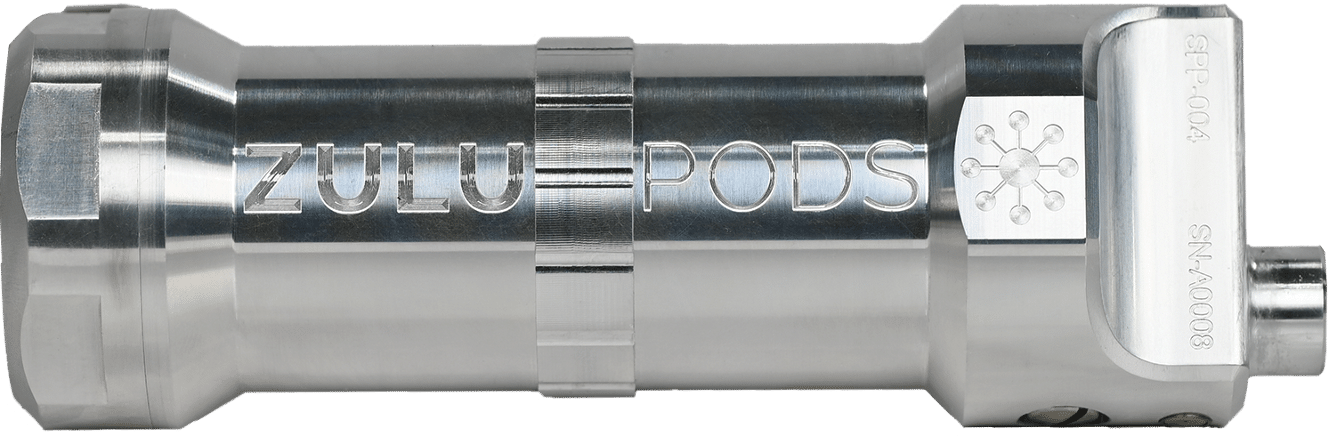
Functionality
Self-Pressurized
Unitized
Sensors & Electronic Controls
Embedded Software
Fluid Agnostic
10 Year Shelf-Life
Proprietary Deployment Technology
The EPOD builds off of Zulu Pods’ patented, flagship product the ZPOD. It evolves the technology into a Smart product by integrating a suite of sensors, electronic controls, and embedded software to form a robust solution that will detect when a loss of lubrication event has occurred and deploy.
Watch the video to learn more about this technology.
Rotorcraft Failure Mechanisms Under LoL
When LoL occurs, systems face immediate and severe stresses, leading to a cascade of mechanical failure modes.
Loss of lubricant results in two immediate problems:
- The removal of the heat dissipation medium
- The cessation of hydrodynamic lubrication
The resulting absence of lubrication under heavy load generates immense heat due to friction.

This heat generation rapidly destabilizes the components.
High temperatures degrade the surface hardness of the gears and bearings, which in turn reduces their ability to carry intended loads.
As the damage progresses, the increased friction accelerates heat production, creating unstable thermal effects that eventually lead to catastrophic failure.
Furthermore, thermal expansion within the system can cause rotating parts to seize.
Due to the chaotic thermal and material characteristics in these conditions, the behavior of the transmission becomes unpredictable when loss of lubrication occurs.
How the EPOD Works
Zulu Pods specializes in fluid delivery and minimal lubrication theory. The engineering team has amassed hundreds of hours of test data on providing minimum amounts of oil to critical hardware. The EPOD will supply a minimal amount of lubrication to each of the critical components, ensuring a film of oil remains.
This film of oil will prevent thermal runaway and subsequent failure.

Zulu Pods utilizes their state of the art, fully instrumented, bearing test rigs to rapidly collect data on minimal lubrication performance on bearings. These rigs have amassed hundreds of hours of run-time. Shown is a small sampling of tests demonstrating steady state temperature performance, when varying the amount of oil delivered. The bearing tested was an angular contact ball bearing spinning 1.21 millions of DN.

Experimental testing at Zulu Pods expands past just establishing minimal lubrication amounts for given hardware. Zulu Pods pushes the boundaries; stress testing hardware to identify breaking points and determine failure modes. Shown left on the graph, an angular contact ball bearing maintaining steady state temperatures for over 5 hours when supplied with as little as 10mL/hour. Shown right are magnified bearings, the first, an angular contact ball bearing that was starved of oil (failure occured in 4 minutes) and the second, an identical bearing that utilized 10 mL of oil an hour, over a 5 hour period.
Validated in partnership with the
Army DEVCOM Aviation and Missile Center (AvMC)

Phase 1 & 2 RDT&E Contract
COMPLETED
Zulu Pods, in conjunction with a major aerospace OEM and the US Army recently completed a Phase 2 RDT&E Contract to develop this technology.
[1] Rosenlieb, J. W. Emergency and microfog lubrication and cooling of bearings for Army helicopters. NASA Technical Reports. 1978. https://ntrs.nasa.gov/api/citations/19780019486/downloads/19780019486.pdf
[2] Sikorsky Archives (Product History): Sikorsky S-70 UTTAS Prototype. https://sikorskyarchives.com/home/sikorsky-product-history/helicopter-innovation-era/sikorsky-s-70-uttas-prototype/
[3] Army Aviation Magazine (1975): YUH-61A – Army Aviation Magazine. https://armyaviationmagazine.com/images/archive/backissues/1975/75_10.pdf
[4] U. S. Army Aviation Troop Command. Aeronautical Design Standard, Rotorcraft Propulsion Performance and Qualification Requirements and Guidelines, ADS-50-PRF. April, 1996.
[5] 14 CFR 29.927. https://www.ecfr.gov/current/title-14/section-29.927
[6] Department of Defense (DoD). Joint Service Specification Guide: Air System, JSSG-2000. 2000.
[7] Transportation Safety Board of Canada. Main gearbox failure and collision with water: Sikorsky S-92A, C-GZCH. Aviation Investigation Report A09A0016. 2009. https://www.tsb.gc.ca/eng/rapports-reports/aviation/2009/a09a0016/a09a0016.html
[8] EASA Certification Memorandum. Large Helicopter Main Gearbox Certification Requirements, CM-RTS-001 Issue 01. November 11, 2013.
[9] TSB Recommendation. Main gearbox certification extremely remote provision, A11-01. February 9, 2011. https://www.tsb.gc.ca/eng/recommandations-recommendations/aviation/2011/rec-a1101.html
[10] Department of the Army. RDT&E Budget Activity 2, R-1 Program Element 0602211A / Aviation Technology, Project 47B / Veh Prop & Struct Tech. March 2014. https://www.asafm.army.mil/Portals/72/Documents/BudgetMaterial/2015/base%20budget/rdte/Budget%20Activity%202.pdf
[11] Michaud, M., Arvin, J. B., & Benson, G. L. AH-64 loss of lubrication study: Test of isotropic superfinished AH-64 (Apache) engine nose gearbox without black oxide coating. Presented at the 44th European Rotorcraft Forum. 2018. https://www.remchem.it/wp-content/uploads/2020/10/155-Loss-of-Lubrication-Test-of-Isotropic-Superfinished-AH-64-D-Apach….pdf
[12] REM Surface Engineering. Rotorcraft gearbox regulations: LOL (not what you think). 2020. https://www.remchem.it/wp-content/uploads/2020/03/Material-Matters-Rotorcraft-Gearbox-Regulations-Material-Matters.pdf
[13] European Union Aviation Safety Agency. “Certification Specification and Acceptable Means of Compliance for Large Rotorcraft. CS-29 Amendment 7”. Refurbishment of Wind Turbine Gears via Surface Finishing. July 15, 2019.
[14] 22 CFR § 121.1, Category VIII(h)(2).
[15] DoD Manual 4160.28, Volume 2, Defense Demilitarization: DEMIL Coding.